

Event fencing is temporary, portable fencing (typically PVC vinyl picket or panel sections on freestanding posts) used to define a perimeter, guide foot traffic, or hold back a crowd at a race, festival, concert, or similar outdoor event. It's a different category from steel crowd barricades, which are heavier, interlock for security-grade crowd holding at stage fronts and entrances, and from bollards, which control vehicle access rather than pedestrian flow. Event fencing is the right tool when the job is defining a boundary or routing people, not stopping a vehicle or holding back pressure from a packed crowd.
Event Fencing by Use Case
Races and running routes. A 5K or similar race route mainly needs lightweight, portable fencing that can be moved along the course and repositioned quickly between the start line, turns, and finish chute. Panels built on freestanding picket posts, which unfold without tools and can be staked on uneven ground, work well here because a small crew can set and strike a long course line faster than with heavier barricade sections, and the fencing only needs to define the route, not resist a leaning crowd the way a stage-front barricade does.

Outdoor festivals. Festival grounds typically need perimeter fencing around the full site, plus internal fencing to separate vendor areas, VIP sections, or age-restricted zones. Traditional and picket-style event fence panels in white PVC vinyl are the standard choice for this because they're weather-resistant, don't rust or warp, and read as a clean, finished boundary rather than a construction barrier, which matters for a paying public event.
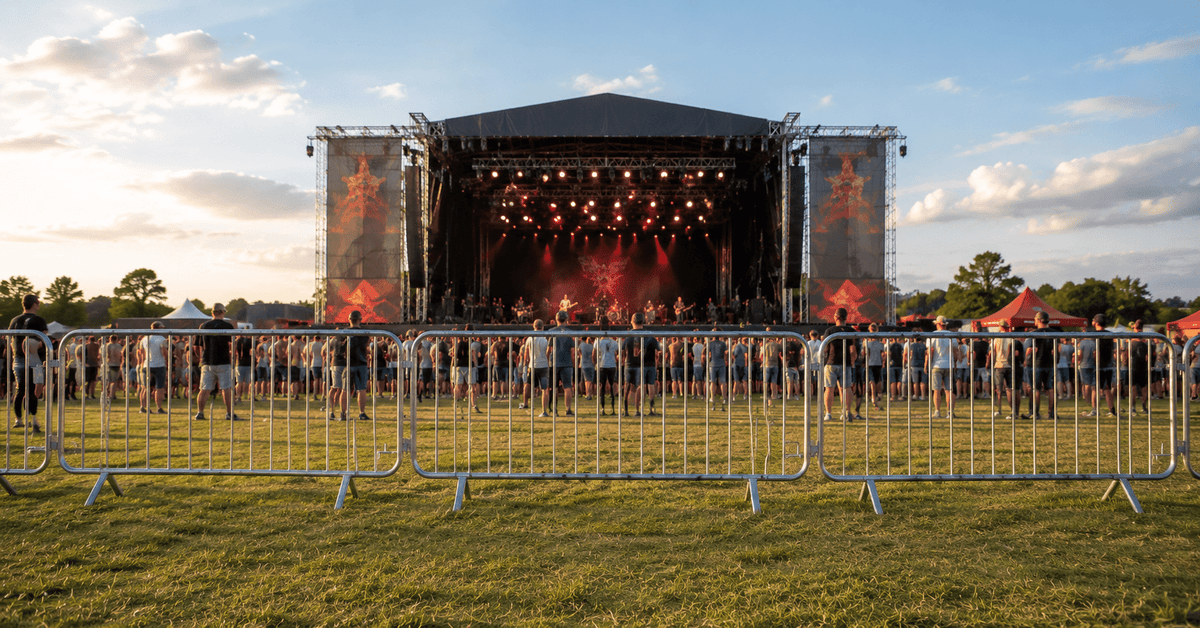
Concerts and large outdoor events. These events usually need two different products working together, not one: event fence panels for the general grounds perimeter, and heavier-duty interlocking steel barricades for the stage front and any area where a dense, pushing crowd is possible. Using event fence panels alone at a stage front isn't the right application; that's what the barricade category is built for. If you're specifying for a concert or festival with a mainstage, our barricade buying guide covers that piece in depth.
Buying Event Fencing Instead of Renting
For any organization running events more than once a year, buying tends to beat renting on cost within a season or two, since rental fees repeat every event while a purchase is a one-time cost that can be reused indefinitely. Owning also means the fencing is available on your schedule rather than whatever a rental company has left during a busy event season, and panels store flat and stack efficiently between uses. Renting still makes sense for a true one-off event or when storage and transport between events isn't practical for your organization.
What Temporary Event Fencing Costs to Buy
Pricing scales with panel type and kit size rather than being a single number. As a reference point from CCW's current online pricing (worth confirming on-site before publishing, since e-commerce pricing changes): individual picket or traditional PVC panels run in the neighborhood of $110 each, complete kits bundling posts and panels for a 60-foot run are priced near $1,790, and a 120-foot kit runs close to $3,590. Decorative panel styles (box, slant, and similar patterns) cost more per panel than the basic white traditional or picket style, generally in the high $200s to low $300s. Buying a complete kit is usually simpler and more cost-effective than assembling posts and panels separately, since kits are sized to standard run lengths and include everything needed to install that length in one order.
How to Choose an Event Fencing Supplier
• Material and weather resistance. UV-inhibited, impact-resistant PVC vinyl holds up to repeated outdoor use across a full event season without rusting, rotting, or warping, which matters more for fencing that gets stored and redeployed than for a single-use rental.
• Kit completeness. A supplier selling complete kits, sized to standard run lengths with posts and panels bundled together, is simpler to order from than one that requires calculating post spacing and ordering pieces separately.
• Warranty coverage. A multi-year warranty is a reasonable proxy for how confident a manufacturer is in the panels holding up to real outdoor conditions over more than one event.
• Style range for different events. A festival or concert with paying attendees often benefits from a more finished, decorative panel style, while a race route or utilitarian perimeter can use basic white panels; a supplier offering both lets one account cover different event types.
• Shipping speed relative to your event date. Event fencing orders are frequently placed against a fixed date that can't move, so a supplier's stated shipping timelines matter more here than for a typical retail purchase.
Frequently Asked Questions
What event fencing do I need for a 5K or running race route?
Lightweight, portable picket-style fence panels on freestanding posts are typically the best fit, since they can be repositioned quickly along a course and don't require the heavier interlocking hardware that stage-front security barricades use.
What type of temporary fencing works best for outdoor festivals?
White PVC vinyl event fence panels, either traditional or picket style, are the standard choice for festival perimeters and internal boundaries (vendor areas, VIP sections) because they're weather-resistant and present a clean, finished look for a public event.
What's the best event fencing setup for a concert or large outdoor event?
Most concerts and large outdoor events need both: event fence panels for the general grounds perimeter, and heavy-duty interlocking steel barricades specifically for the stage front and any area where crowd pressure is a real possibility. Event fence panels aren't designed to hold back a dense, pushing crowd.
How much does temporary event fencing cost to buy?
It depends on panel style and kit size. Individual panels commonly run around $100 to $110 each, complete kits for a 60-foot run are typically in the $1,700 to $1,800 range, and 120-foot kits run roughly double that. Decorative styles cost more per panel than basic white panels. Confirm current pricing directly, since online prices change.
Is it cheaper to buy or rent event fencing?
For an organization running more than one or two events a year, buying is usually cheaper over time than repeat rental fees, and it means the fencing is available on your own schedule. A true one-time event, or one where storage between uses isn't practical, is where renting still makes sense.