
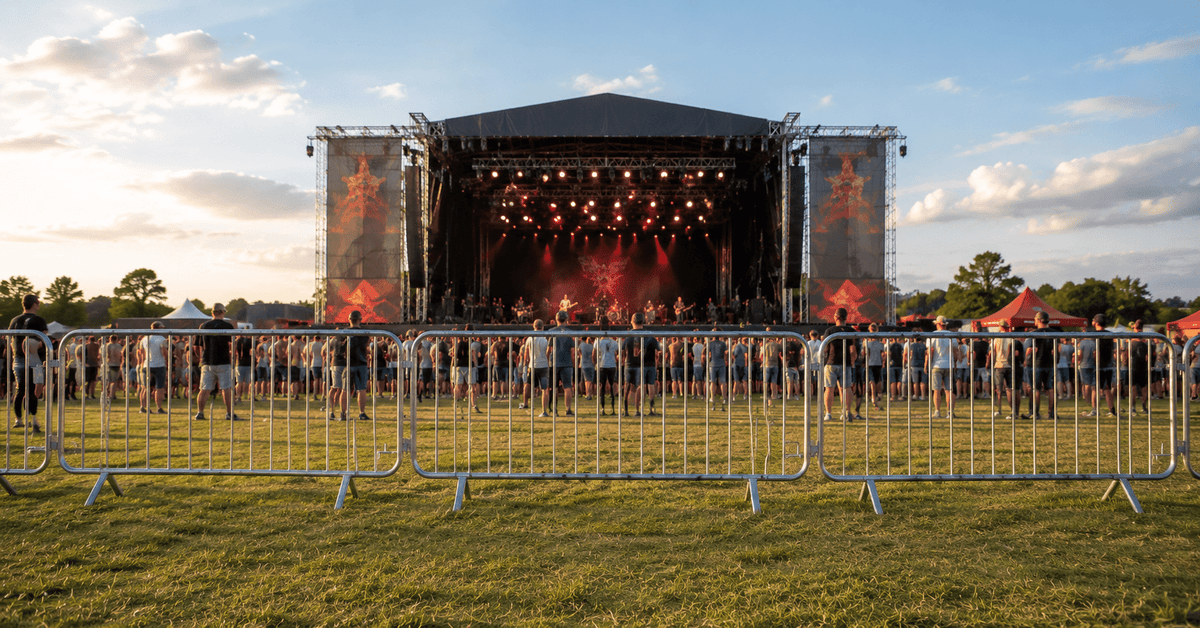
Choosing the right barricade isn’t just a purchasing decision, it’s a safety decision. The wrong barrier creates liability. The right one becomes invisible, doing its job so well that nobody gives it a second thought.
A barricade is a rigid, heavy-duty barrier designed to obstruct passage, control crowd movement, or redirect vehicle traffic. Unlike lighter options such as retractable belt stanchions or caution tape, barricades are built to physically withstand crowd pressure, harsh weather, and repeated use in demanding outdoor environments.
Whether you’re managing a concert, securing a construction site, routing a parade, or protecting an airport terminal, this guide breaks down every major barricade category, explains when and why to use each type, and helps you understand the differences in material and finish that affect long-term performance and cost.

Steel Barricades: The Industry Standard for Crowd Control
Steel barricades, sometimes called “bike rack barricades” because of their tubular frame design, are the most widely used barricade type for managing large outdoor crowds. They are the barriers you see lining parade routes, flanking concert stages, and securing festival perimeters around the world.
Every steel barricade features interlocking hook-and-loop connectors at each end, allowing individual units to link together into a continuous, gap-free barrier line. Once linked, the entire line functions as a single unified structure, making it extremely difficult for anyone to push through, pull apart, or breach the perimeter.

Hot-Dipped Galvanized Steel Barricades
Hot-dipped galvanizing is the gold standard for outdoor steel barricade protection. The fully assembled barricade is submerged in a bath of molten zinc, coating every surface (including weld joints, seams, and tube interiors) with a thick, uniform zinc layer typically 45–85 micrometers thick. This process provides both barrier protection (blocking moisture and oxygen) and sacrificial protection (zinc corrodes before steel does, even if the surface gets scratched or dented).
Hot-dipped galvanized barricades are recognizable by their characteristic “spangle” finish, an irregular crystalline pattern on the surface. This is not a defect; it’s the hallmark of genuine hot-dip treatment.
Best for: Permanent outdoor deployment, venues that store barricades outside year-round, coastal or high-humidity environments, and organizations that need barricades to last a decade or more with minimal maintenance.
Pre-Galvanized (Economy) Steel Barricades
Pre-galvanized barricades use steel tubing that is zinc-coated before the barricade is assembled, at the mill level rather than as a finished unit. This makes them significantly less expensive. The trade-off: cut edges and weld joints remain uncoated and can become entry points for rust over time. They also carry a thinner zinc layer (20–30 micrometers vs. 45–85 for hot-dipped) and a smoother, more uniform finish.
Best for: Indoor events, seasonal outdoor use with covered storage, budget-conscious organizations, and applications where barricades are transported frequently and lighter weight is an advantage.
Powder-Coated Steel Barricades
Powder coating applies a dry powder electrostatically to the steel surface, then cures it in an oven into a hard, smooth finish. The biggest advantage is customization, powder-coated barricades can be finished in virtually any color, from high-visibility safety yellows to custom Pantone-matched brand colors. Powder coating can also be layered over a hot-dipped galvanized base for double protection.
Best for: Branded events, venues with specific color schemes, organizations that need high-visibility safety coloring, and applications where barricades serve a dual aesthetic and functional purpose.
Plastic Barricades: Lightweight, Versatile, and Fast to Deploy
When speed of deployment, portability, and ease of handling matter more than maximum crowd-holding strength, plastic barricades are the right tool. Constructed from high-density polyethylene (HDPE), these barriers are designed to be set up, repositioned, and torn down quickly, often by a single person.

Pedestrian Plastic Barricades
Pedestrian plastic barricades are compact, interlocking panels designed to guide foot traffic at events, sidewalk closures, and construction zones. Lightweight enough for one person to carry and position, yet sturdy enough to clearly delineate a restricted area. Available in multiple high-visibility colors and with optional signage attachments for directional information or sponsor messaging.
Best for: Sidewalk detours, fun runs and walk-a-thons, outdoor dining perimeters, festival pedestrian channels, and any situation requiring fast setup and teardown.
Water- and Sand-Fillable Jersey Barriers
For applications requiring serious weight and impact resistance (highway construction zones, parking lot perimeters, airport terminals), fillable plastic jersey barriers ship lightweight and empty, then are filled with water or sand on-site to achieve ballast weight that can exceed 1,000 pounds per unit. Available in heights from compact 10-inch airport barriers to heavy-duty 42-inch roadway versions.

Expandable Barricades: Adjustable Coverage for Dynamic Environments
Expandable barricades (also called accordion or scissor barricades) are collapsible barriers that stretch from a compact folded width to cover a wide span, then retract for easy storage. They are the go-to solution for environments where the required barrier length changes frequently, or where storage space is limited.
Metal models feature steel and aluminum scissor frames that extend to 11 or 16 feet. Lighter plastic models offer similar flexibility at reduced weight. Most come equipped with locking casters, pull levers for quick adjustments, and high-visibility OSHA safety colors: yellow/black for caution, red/white for danger.

Best for: Warehouses, retail stockrooms, airport terminals, convention centers, janitorial areas, emergency access points, and anywhere requiring on-demand access control deployed in seconds.
How to Choose the Right Barricade
Four questions will narrow down the right barricade for virtually any application:
-
What are you containing? High-energy crowds need interlocking steel barricades. Vehicle traffic requires ballasted jersey barriers. General pedestrian guidance can use lighter plastic barricades.
-
Indoor or outdoor? Outdoor environments demand hot-dipped galvanized or powder-coated finishes. Indoor environments can use pre-galvanized steel or plastic without weather concerns.
-
How often will you set up and tear down? Infrequent deployments favor heavier, durable steel. Frequent cycles benefit from lighter plastic or expandable barricades.
-
What’s your budget and time horizon? Pre-galvanized barricades cost less upfront. Hot-dipped galvanized units cost more initially but can deliver decades of service with minimal maintenance.